Goldman Sachs is opening access to FTIXX through LYNQ on Avalanche, linking traditional fund exposure with institutional crypto workflows. What it means for $AVAX 👇
Goldman Sachs is opening access to FTIXX through LYNQ on Avalanche, linking traditional fund exposure with institutional crypto workflows. What it means for $AVAX 👇
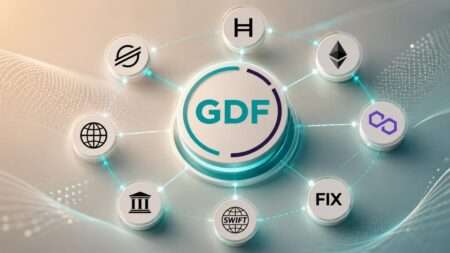
Global Digital Finance just published the results of an industry sandbox involving over 70 participants — including BlackRock, JPMorgan, Goldman Sachs, State Street, Franklin Templeton, Lloyds Banking Group, the London Stock Exchange Group, Commerzbank, Northern Trust, Fireblocks, and more — that tested tokenized money market funds across multiple public and private distributed ledgers. Stellar, Hedera, Ethereum, Polygon, and Canton were among the chains used. The work is now production-ready in Europe and the UK, with the US going live next.
Citi Institute’s new Tokenization 2030 report projects the global tokenized asset market will grow from approximately $17 billion today to $5.5 trillion by 2030 in the base case, with $8.2 trillion in the bull case. The report explicitly names Stellar, Ripple, and Chainlink in its discussion of the infrastructure powering Wall Street’s on-chain transition. Here’s what the report actually says — and how it lines up with everything else that has been announced over the past two weeks.
Most of crypto Twitter doesn’t remember that IBM built one of the first production-grade cross-border payment systems — World Wire — on Stellar in 2019, with 47 currencies and 72 countries. IBM scaled that work back, but the 2026 IBM Institute for Business Value outlook for banking and financial markets just doubled down on tokenization. With DTCC’s Stellar connection now public, the historical IBM-Stellar bet looks very different in hindsight.

Dell Federal Systems just won a roughly $9.7 billion software contract from the Pentagon to deliver Microsoft licenses, cloud subscriptions, and software assurance to the US military. That’s today’s news. The longer story most crypto coverage will miss: Dell has been on Hedera’s Governing Council since February 2023, runs a Hedera node, and is part of the EQTY Labs verifiable compute stack. Here’s what to actually take from this.

The Depository Trust and Clearing Corporation — the post-trade backbone of US capital markets that custodies over $14 trillion in assets — just announced it will connect its tokenization service to Stellar. US Treasuries, Russell 1000 constituents, and ETFs are heading on-chain via Stellar in H1 2026.

VersaBank — by its own description the world’s first fully digital bank — just launched a US pilot program tokenizing US dollar bank deposits on Algorand, Ethereum, and Stellar. Confirmed by SEC filing. This is a different category of token from stablecoins: actual bank deposits, FDIC-eligible, interest-bearing. And Algorand was one of three chains chosen.

Hyperliquid is the most efficient exchange in crypto right now — fully on-chain perpetual futures running through a central limit order book, a custom Layer 1 with 200,000 orders per second, $14B market cap, and an 11-person team that out-earns Apple, Tether, and Nvidia per employee. Here’s what it is, how it works, and why Coinbase, Circle, and Ripple just bought in.

Australia’s Reserve Bank just published the final Project Acacia report — and one of the seven pilots ran an end-to-end Australian Government bond lifecycle on the XRP Ledger with settlement in RLUSD, Ripple’s stablecoin. Custody via JPMorgan. Ripple Labs, Chainlink, and Fireblocks all on the same use case.

The Reserve Bank of Australia’s final Project Acacia report puts Hedera at the heart of its wholesale CBDC and tokenization pilots — used in four of the program’s use cases, including Australian Payment Plus, Imperium Markets, and a settlement infrastructure powering trials with NAB, Westpac, Colonial First State, Bank of Queensland, and Australian Super.