AI Summary
- DTCC is positioning tokenization as an additional format for existing assets and multiple forms of settlement cash.
- BIS remarks on Project Agora show that atomic settlement is only one component of a broader financial architecture.
- The FCA and SEC are developing regulated pathways for crypto businesses and tokenized securities.
- The institutional direction is becoming clearer, but the evidence does not establish which public blockchain will capture the activity.
- Our analysis separates infrastructure adoption from speculative claims about crypto prices or the decline of the existing financial system.
The familiar crypto narrative is that established finance must collapse before blockchain infrastructure can succeed. The more concrete development is less dramatic and more consequential: DTCC, the ECB, the BIS, the FCA and the SEC are each examining practical ways to bring tokenized assets into regulated financial markets.
The remarks collected in the source recording do not prove that the financial system is moving wholesale onto public blockchains. They do show institutions working on asset representation, central bank money, tokenized deposits, stablecoins, regulatory authorization and atomic settlement. In our view, that combination is more important than any unsupported claim that one network has already been selected.
Institutional rails are moving from concept to choice
DTCC’s stated proposition is not that every security must be tokenized or that one form of digital cash must dominate. The emphasis is optionality. Market participants could use eligible assets in a tokenized form while selecting an appropriate settlement mechanism, including stablecoins, tokenized bank deposits or an asset for asset exchange without a cash leg.
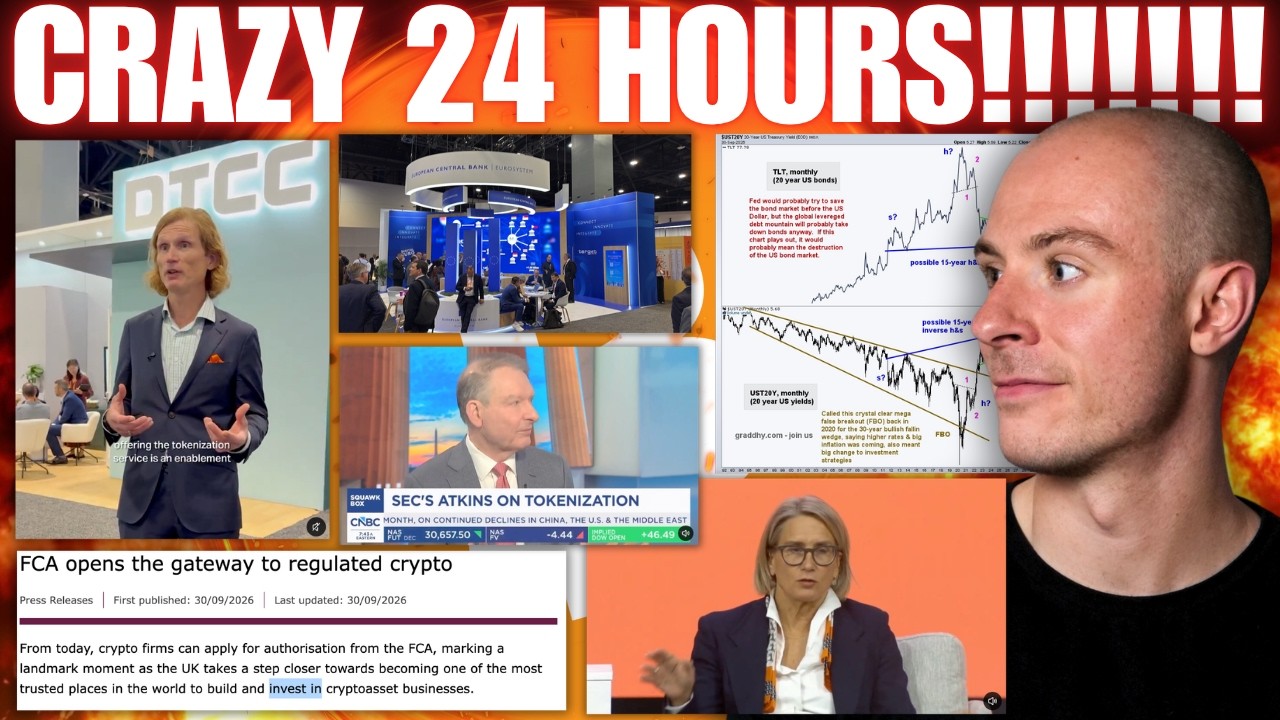
So the biggest takeaway from the panel today was really DTCC in offering the tokenization service is an enablement to the market to bring choice to be able to use our assets in the form that members want to use it that the market wants to use it.
This is a market infrastructure thesis, not necessarily a cryptocurrency adoption thesis. Tokenization changes how an asset can be represented, transferred and connected to payment mechanisms. It does not, by itself, determine whether the underlying ledger will be public, private or connected through an interoperability layer.
- Asset choice: Participants may be able to use a tokenized representation where the service and market rules permit it.
- Cash choice: Settlement could involve stablecoins, tokenized deposits or another supported arrangement.
- Operational choice: An asset versus asset transaction may not require a conventional cash leg.
The distinction matters because distributed ledger technology can be adopted inside existing regulated structures without transferring control of securities markets to a public crypto network. The institutional opportunity is real, but its final architecture remains unsettled.
Atomic settlement is narrower than instant settlement
The BIS remarks concerning Project Agora provide an important technical boundary. The objective described in the recording is to align the components of a transaction so they can settle together. That is different from claiming every stage of a transaction becomes immediate.
Can you settle in one go? This is just one piece.
Central bank money can provide finality for a cash leg, but a complete transaction may also require securities, foreign exchange, messaging and other operational components. The BIS contribution described here is therefore a trust and settlement component within a larger ecosystem, not a finished replacement for the entire market stack.
But this is where the private sector comes in. We’re just making sure we bring that trust piece at the core
That invitation creates room for private infrastructure providers, but it should not be read as confirmation of any particular blockchain. Even where public ledgers are technically possible, institutions still have to address identity, legal finality, asset servicing, liquidity, privacy and integration with existing systems.
- Atomic does not mean universally instant: The relevant legs must first be aligned.
- Central bank money addresses one requirement: Securities and foreign exchange components still have to connect.
- Private providers remain necessary: Public institutions are not presented as building every part of the stack.
The ECB is building a bridge rather than a clean break
The recording identifies Pontes as an ECB initiative intended to bridge the Eurosystem’s traditional TARGET payment infrastructure with distributed ledger market platforms. That design points toward coexistence. Existing central bank rails remain part of the architecture while tokenized markets gain a route to central bank settlement.
The supplied context also connects Axiology with an XRP Ledger based settlement system participating in the Pontes landscape. Our earlier analysis examined that relationship in detail in ECB Pontes Connects Axiology’s XRP Ledger Based Settlement System. This is evidence of a specific participant’s technical design, not proof that the ECB has chosen XRP Ledger as the universal foundation for its tokenization work.
That qualification is essential. Institutional programs frequently involve multiple platforms, experiments and providers. Participation can validate a network’s ability to meet a defined use case while leaving broader procurement, production scope and transaction volumes unresolved.
Regulators are defining pathways for market entry
The FCA material presents a route for crypto firms to apply for authorization ahead of a new UK regime. According to the supplied statement, firms intending to continue operating in the UK should apply by February 28, 2027, before the regime comes into force on October 25, 2027. The stated standards cover consumer protection, safeguarding, market integrity and financial resilience.
For the first time, crypto firms operating in the UK will be brought into full FCA regulation with clear standards uh covering consumer protection, safeguarding, uh market integrity and financial resilience.
In the United States, SEC Chair Paul Atkins described work with the CFTC on distinctions between tokenized securities and other tokenized assets. He also referred to a proposed framework for raising money onchain and an innovation exemption intended to provide a controlled environment for issuing and trading securities onchain.
So we’re trying to move things onchain which I think is an exciting uh prospect and so we’re moving forward.
The key regulatory distinction is between a token that represents the actual rights and privileges of a security and a synthetic product that merely tracks something else. The former requires rules for issuance, ownership, trading and investor protection. Our previous examination of the SEC tokenization push reached a similar conclusion: policy progress can expand the addressable market without confirming the infrastructure winners.
Public blockchain participation remains possible, not proven
The source material repeatedly moves from institutional tokenization to expectations about public distributed ledgers. That outcome is possible, but the cited institutional remarks do not establish it. They support a more limited conclusion: regulated entities want interoperable infrastructure capable of connecting assets, money and established financial controls.
- Supported by the source: Institutions are developing tokenization, settlement and regulatory frameworks.
- Still uncertain: Whether production systems will use public, permissioned or hybrid ledgers.
- Not established: That a named crypto asset will absorb the value represented on those systems.
- Commercial question: Which providers can satisfy legal, technical and operational requirements at scale.
The difference between infrastructure use and token value capture should remain central to any investment analysis. A network may be used without its native asset becoming the principal settlement instrument. Likewise, an interoperability provider may facilitate a transaction without controlling the asset or cash layer.
Macro stress does not validate the tokenization thesis
The source also links rising sovereign bond yields and pressure in debt markets to the emergence of tokenized finance. We see these as separate analytical questions. Higher yields may create operational or policy pressure, but they do not demonstrate that tokenized markets will replace the existing monetary system.
Tokenization can improve how assets and payments interact while leaving the underlying credit risk, duration risk and fiscal exposure unchanged. Putting a bond on a ledger does not alter the issuer’s obligation. It may change settlement mechanics, collateral mobility, record keeping or market access, but the economic claim remains tied to the same issuer.
The same caution applies to the source’s forecast for crypto market capitalization excluding Bitcoin. It is an attributed market opinion, not an institutional projection, and the material supplied does not provide enough evidence to validate it. Regulatory acceptance of tokenized securities should not be converted mechanically into a price target for unrelated crypto assets.
What this means
Tokenization is becoming a market structure project. DTCC’s focus on asset and cash choice, the ECB’s bridge to ledger platforms and Project Agora’s settlement work all concern the mechanics of regulated finance.
Regulatory clarity is moving closer to implementation. The FCA authorization pathway and the SEC’s work on issuance and trading indicate that policymakers are defining how firms may operate, rather than considering tokenization only as a theoretical concept.
Infrastructure selection remains open. XRP Ledger, private networks and interoperability technologies may participate in specific deployments, but the supplied evidence does not support declaring a universal chain or token winner.
Bigger picture
The institutional pattern extends beyond a single program. The supplied AllinCrypto reporting shows investment banks examining tokenized repo as standards develop, while The Clearing House has selected Quant for a tokenized deposit network. These developments reinforce the view that tokenization is advancing through specialized projects rather than one synchronized migration.
The cash side is equally important. Our coverage of how Quant connects UK and US bank rails to tokenized deposits illustrates why interoperability with established payment systems may matter as much as the ledger hosting an asset. The emerging structure is therefore likely to involve multiple regulated networks, messaging systems and settlement assets.
Our measured view is that institutional adoption is becoming easier to document, while claims about a complete replacement of the old system remain premature. The strongest thesis is not that regulated finance disappears. It is that regulated finance is adding programmable asset and settlement layers, with competition still open over who provides them.
Sources
This article is for informational purposes only and does not constitute financial advice.