AI Summary
- Institutional demand has strengthened Bitcoin without creating an equivalent source of capital for most altcoins.
- Rapid token issuance is dividing limited liquidity and attention among an expanding universe of assets.
- Ethereum, Solana, BNB and other surviving networks still need measurable activity and credible value capture.
- Stablecoins, tokenization and real world assets are emerging as stronger adoption channels than many crypto native applications.
- The traditional altcoin cycle is becoming less reliable as financial infrastructure and equity ownership absorb more of the sector’s economic value.
The familiar altcoin thesis assumes that capital first enters Bitcoin, rotates into major networks and eventually spreads across smaller tokens. That sequence is becoming harder to defend. Institutional adoption has created a substantial access channel for Bitcoin, while most altcoins still depend on fragmented retail liquidity, speculative attention and token specific narratives.
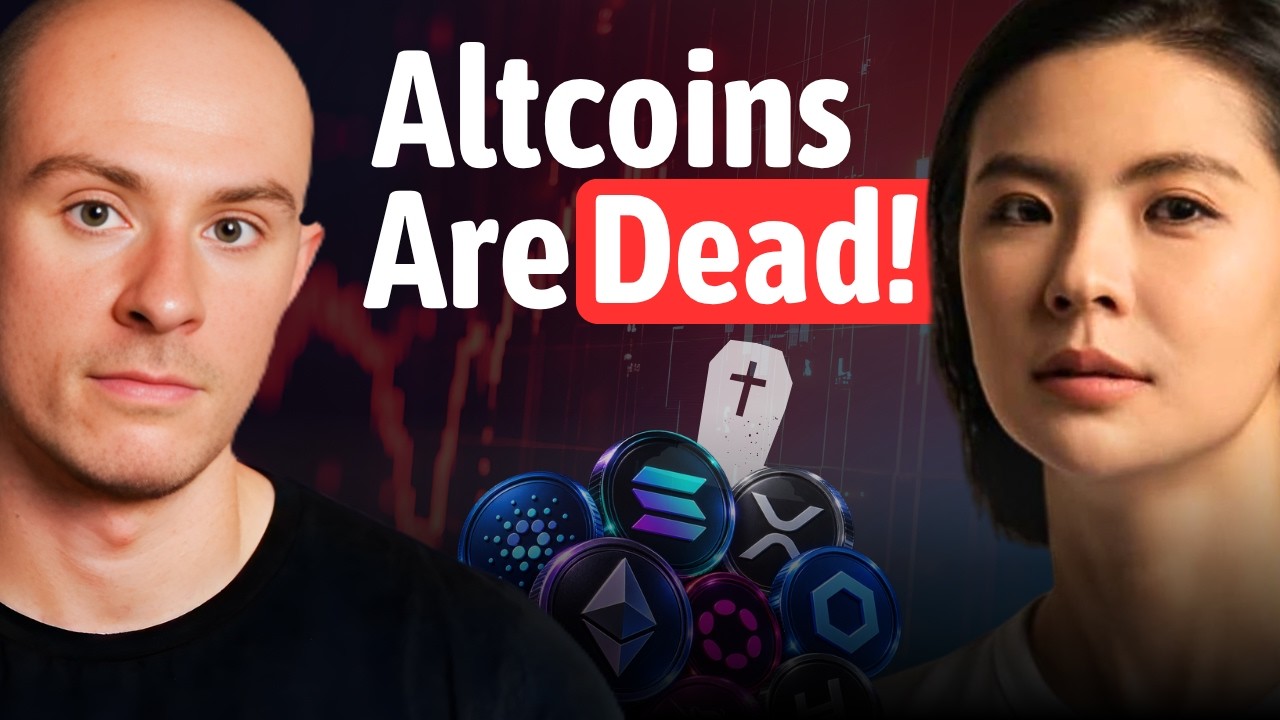
Bitget CEO Gracy Chen describes the imbalance in stark terms: institutional money has concentrated around Bitcoin while the supply of tradable tokens has continued to expand. Her argument does not prove that every altcoin is economically obsolete. It does, however, identify the central problem facing the sector: an asset can support useful technology without giving its token a durable claim on the value created.
Our analysis is that the market is separating into three layers. Bitcoin is consolidating its role as a scarce macro asset, a theme also examined in our analysis of its dollar hedge case. A small group of networks must prove that usage creates token demand. Meanwhile, stablecoins, tokenization and regulated businesses may capture economic value through transaction activity or equity ownership rather than broad altcoin appreciation.
Institutional capital has not lifted the whole market
Chen’s core observation concerns the destination of new money. In her assessment, the most important capital inflow of recent years has come through institutional adoption, including Bitcoin exchange traded funds and digital asset treasury strategies. Comparable vehicles for smaller assets are either absent or have attracted less demand.
if you want something’s price to go up right there has to be capital inflow
This creates a structural distinction between Bitcoin and the rest of the market. Bitcoin can receive allocations from investors who want regulated exposure to a scarce digital asset without interacting directly with crypto infrastructure. Most altcoins still need buyers who understand a particular network, accept its technical and regulatory risks, and believe its token will benefit from adoption.
That does not guarantee Bitcoin appreciation or eliminate its volatility. Chen characterized current conditions as unusually unstable and remained uncertain about whether the market had entered a durable bull phase. Interest rates, dollar conditions, United States policy and the possibility of another disruptive event all remain sources of uncertainty. Our related assessment of Bitcoin, yields and dollar volatility likewise treats the macro relationship as conditional rather than automatic.
I would rather call it a monkey market because monkey jumps up and down.
Token abundance is diluting liquidity and attention
The second pressure is supply. Creating a token has become easier, but the capital and attention available to support those tokens have not expanded at the same rate. Chen cited platforms capable of enabling enormous volumes of new issuance as evidence of the imbalance. The exact number of tokens created on any day can fluctuate, but the underlying mechanism is clear: more assets are competing for a limited pool of buyers.
who buys the altcoins?
A useful altcoin therefore needs more than a community and an exchange listing. It needs a credible connection between adoption and token demand. Investors should be able to identify how usage affects fees, staking, collateral demand, governance or another economically relevant function.
- Capital source: Who is expected to buy the token after its initial distribution?
- Value connection: Does greater network usage create demand for the asset?
- Supply discipline: Can issuance, incentives and unlocks overwhelm organic demand?
- Competitive need: Does the project provide a product that users cannot obtain more efficiently elsewhere?
Our view is that this framework is more useful than waiting for a market wide rotation. Some tokens can still outperform, but isolated rallies do not establish a sustainable altcoin cycle. They may instead reflect temporary scarcity, leverage or concentrated speculation.
Surviving chains need measurable product market fit
Chen identified Ethereum, BNB and Solana as examples of networks whose tokens could remain connected to activity. The relevant tests are not brand recognition or historical market capitalization. They are active users, transaction demand, gas fees and the persistence of applications that people continue to use when speculative enthusiasm declines.
we don’t need like 30 different public chains of course
This is deliberately more demanding than the idea that every successful blockchain application must lift its underlying asset. A network can process transactions while competition keeps fees low. Applications can retain revenue that might otherwise accrue to the base layer. Users can also hold stable assets without maintaining large positions in the chain’s native token.
The distinction also matters for valuation. Our examination of the Chainlink valuation thesis applies the same basic discipline: technical importance and token value capture are related questions, but they are not identical. Networks that survive consolidation will need to demonstrate both utility and an economic reason for holding their assets.
- Security: Applications need settlement they can trust.
- Cost: Users need fees that fit the value of the transaction.
- Distribution: Developers need access to users and liquidity.
- Retention: Activity must persist beyond incentive programs and speculative cycles.
Stablecoins are becoming blockchain’s practical interface
Bitcoin increasingly functions as digital scarcity, while stablecoins provide a more practical medium for trading and cross border payments. Chen specifically distinguished USDC, issued by Circle, from the governance and utility assets commonly described as altcoins. Circle can capture business value through its corporate structure even though USDC is designed to maintain a stable value rather than appreciate like a conventional crypto asset.
stable coins are more built for AI than built for human being.
That statement is Chen’s forward looking opinion, not an established outcome. The reasoning is nevertheless worth testing. Software agents may need payment systems that operate continuously and do not require each agent to open a conventional bank account. Stablecoin rails could fit that requirement, especially when combined with automated trading and other forms of artificial intelligence.
The unresolved issue is whether this activity benefits native chain tokens, stablecoin issuers, exchanges or application providers most directly. Stablecoin growth can increase blockchain usage without distributing value evenly across the crypto market. It may even reinforce a small number of settlement networks while leaving many unrelated assets behind.
Tokenized markets shift value toward products and platforms
Real world assets, commonly shortened to RWA, form the other major adoption channel in Chen’s thesis. She said tokenized private credit and money market funds have achieved greater penetration than tokenized equities, but still represent a small share of their underlying markets. She also presented a personal scenario in which tokenization could reach a 10% share across financial asset classes by 2030. That is her forecast and should not be treated as a verified market projection.
The stronger analytical point is that traditional assets can gain blockchain based distribution without creating a new speculative token for every company or product. A tokenized equity remains a claim connected to an equity. The venue, issuer, custodian and settlement network may earn revenue, but that does not automatically produce demand for unrelated crypto assets.
- Longer availability: Tokenized products can move markets toward broader trading access.
- Programmable collateral: Eligible assets can potentially support other positions within a unified account.
- Global distribution: Platforms can serve users beyond a single domestic market schedule.
- Operational complexity: Regulation, custody and settlement remain essential constraints.
Verified developments supplied to AllinCrypto show that this trend is not confined to one venue. Hanwha Securities has built a tokenization platform on Avalanche, while a separate industry test covered tokenized money market funds involving Stellar and Hedera. These examples support the broader direction of travel, although they do not validate every adoption estimate or guarantee value accrual to network tokens.
Bitget is betting on a universal trading model
Bitget’s response is to expand beyond the conventional centralized exchange model. Chen described the company as a universal exchange intended to combine cryptocurrencies with equities, commodities, foreign exchange exposure and stablecoin based payments. She said more than half of its users hold both cryptocurrency and equity, and that non crypto assets generated as much as 40% of trading volume at a peak cited during the discussion. These are company figures provided by Chen and were not independently documented in the supplied material.
The strategy reveals where an exchange operator expects value to accumulate. Bitget is considering an initial public offering route rather than relying on a new altcoin to represent the company. Its proposed competitive set is also widening from crypto exchanges to broader trading platforms.
Chen described a second phase focused on capital efficiency, including a unified account in which a tokenized asset could serve as collateral for crypto trading. That could make tokenization useful to customers even when they have little interest in the underlying blockchain. It also concentrates responsibility in the platform’s custody, risk and liquidation systems, making implementation quality as important as access.
What this means
1. Bitcoin strength does not promise an altcoin rotation. Institutional access has created a distinct demand channel for Bitcoin. Investors should not assume that this capital will automatically migrate into smaller assets.
2. Usage must connect to ownership. A blockchain can be technically useful while its native token captures little of that utility. Fees, collateral demand, staking economics and supply policy matter more than activity claims in isolation.
3. Financial infrastructure may capture the next wave. Stablecoin issuers, tokenization providers and trading platforms can benefit from blockchain adoption through products and equity value. That outcome would expand crypto infrastructure without producing a universal rise in altcoins.
don’t be too caught up by the history
Bigger picture
The supplied recent coverage points to two trends moving together. Policy remains capable of changing market access, as reflected in the uncertain path described in our coverage of the US Crypto Clarity Act. At the same time, institutions are testing named chains for specific settlement, tokenization and data functions rather than adopting the entire altcoin market as one category.
We therefore see the phrase “altcoins are dead” as a deliberately extreme diagnosis of a genuine allocation problem, not a literal forecast that every non Bitcoin asset will disappear. The more defensible conclusion is that the old market wide narrative is weakening. Capital is becoming selective, issuance remains abundant, and adoption increasingly favors products with a clear legal claim or operational purpose.
For investors and researchers, the task is no longer to identify a generic altcoin season. It is to determine which networks are indispensable, which tokens capture the resulting economics and which businesses may retain that value elsewhere. The answer will differ by project, and it may be equity, a stable asset or a service provider rather than a native token.
Sources
This article is for informational purposes only and does not constitute financial advice.