AI Summary
- 21Shares sees investor demand moving beyond passive crypto exposure toward derivatives, active strategies and defined outcomes.
- The firm’s Anthropic pre IPO ETP illustrates how perpetual futures can package speculative exposure without conveying shares or voting rights.
- Options and perpetual futures may expand risk management, but liquidity, counterparty exposure and product structure remain decisive.
- Artificial intelligence could simplify crypto interfaces while privacy and infrastructure projects explore a deeper connection between the two technologies.
- Our analysis finds evidence of product maturation, but not enough independently verified information to declare a durable crypto market bottom.
Crypto market debate often collapses into a single question: has the bottom arrived? The more concrete development is not a price forecast but a change in market structure. 21Shares sees demand extending beyond passive Bitcoin exposure into crypto derivatives, active products and strategies designed around specific outcomes.
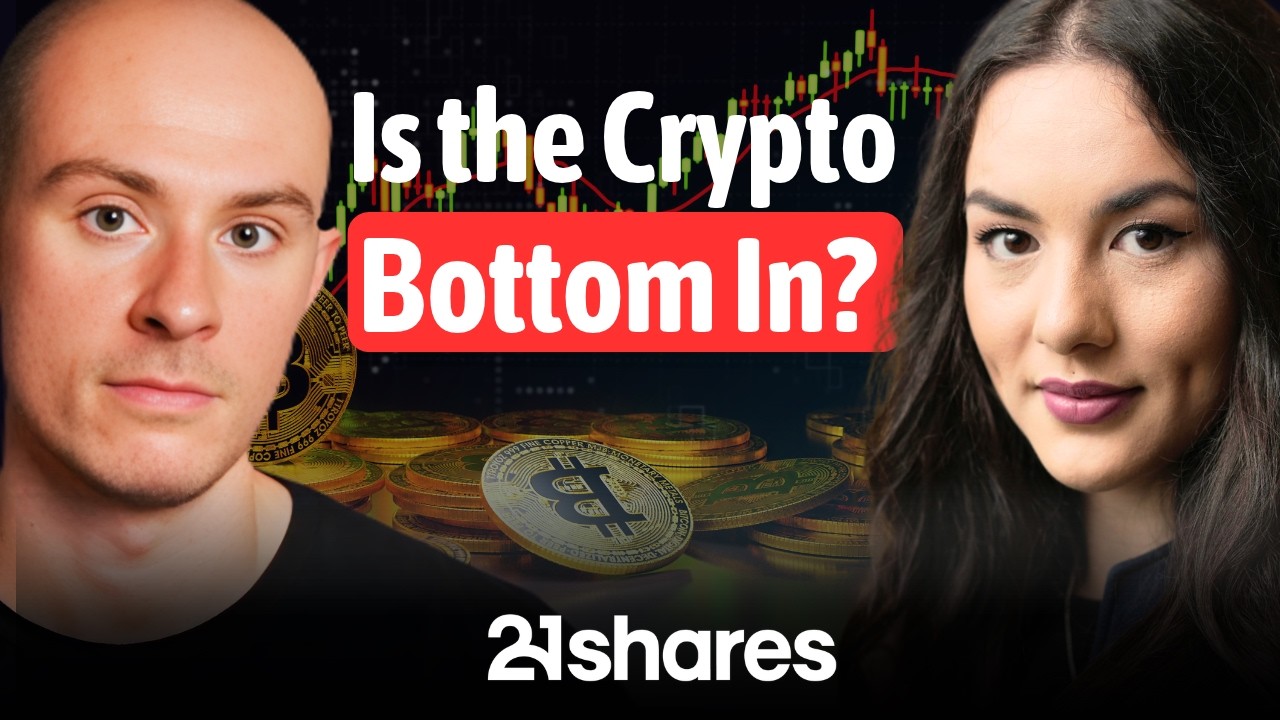
That shift matters because it suggests the industry is starting to resemble a broader financial market rather than a collection of directional token bets. In an AllinCrypto interview, Jasmine, identified as 21Shares’ head of product development, described growing interest in perpetual futures, options and pre IPO exposure. These instruments can widen access and improve risk management, but they also introduce liquidity, counterparty and structural risks that spot ownership does not carry in the same form.
Our analysis is therefore more measured than a simple bottom call. Crypto product development appears to be maturing, while the durability of market prices remains uncertain. Institutional packaging can bring patient capital and better tools, but it cannot remove the underlying risks of leverage, thin markets or imperfect reference prices.
Market resilience is not proof of a bottom
Jasmine offered a clear personal opinion on the direction of the market:
So, my personal crystal ball says it has bottomed.
She connected that view to 21Shares research about the familiar four year crypto cycle and to the market’s ability to absorb a series of shocks. This remains an attributed forecast, not an established market fact. A cycle can appear intact until new information changes liquidity, positioning or investor expectations.
The stronger part of the thesis is structural. Jasmine argued that investors have become more sophisticated and that capital entering through regulated products is more patient than capital driven purely by short term speculation. The weaker part is timing: product adoption does not establish where prices will trade next.
- Constructive signal: Investors are asking how existing crypto holdings can support more deliberate strategies.
- Unresolved variable: Market resilience after a shock does not guarantee that selling pressure has ended.
- Key distinction: Failures at a service provider should be separated from failures of a blockchain’s underlying rules.
Bitcoin’s institutional path is also being shaped by custody and regulation, themes examined in our coverage of the SEC crypto custody proposal. Those foundations may support adoption, but they cannot validate a precise market bottom.
Derivatives are moving beyond directional exposure
The most important product trend in the interview was the movement from simple Delta 1 exposure toward defined outcomes. A Delta 1 product broadly seeks to track the performance of an underlying asset. A more structured strategy may instead use futures or options to shape gains, losses or hedges under particular conditions.
derivatives such as futures or options, they allow to express your your view on certain outcomes and they also allow you to manage risk.
This is the practical case for derivatives. An investor does not have to express only a bullish or bearish view. Instruments can be combined to seek income, limit a defined risk or prepare for volatility. The actual result depends on pricing, execution, fees and the solvency of the relevant counterparties.
- Perpetual futures: Open ended contracts can provide continuous exposure without a fixed expiry date.
- Options: Contract terms can be used to express views about specific outcomes or manage risk.
- Active products: A manager selects exposures rather than mechanically holding a fixed group of leading assets.
Jasmine identified Hyperliquid as an important perpetuals venue and Derive as a project attracting attention in the options market. She characterized Derive as much smaller than Bitcoin and Ethereum, while suggesting it could become significant within its category. That comparison is a guest thesis, not a forecast we can independently confirm from the supplied material.
Pre IPO exposure separates performance from ownership
21Shares’ Anthropic pre IPO ETP provides the clearest example of how the new product architecture works. Jasmine described it as a Europe only product that offers performance exposure rather than equity ownership. Investors do not receive shares, voting rights or a direct interest in Anthropic itself.
So you don’t get any voting rights. You’re not becoming a shareholder.
According to her description, the structure begins with Anthropic perpetual contracts trading on Binance. Kao, identified in the interview as a registered index provider, derives a reference rate from trading and order book information. 21Shares then obtains exposure from its parent company, Falcon X, which hedges through the underlying perpetuals.
The distinction is crucial. A pre IPO ETP tied to a derivative price is not economically identical to private company stock. Its performance depends on how market participants price the contract, how the reference rate is constructed, how effectively the exposure is hedged and whether sufficient liquidity remains available.
- What the investor receives: Exposure linked to the performance of a perpetual contract.
- What the investor does not receive: Anthropic shares, shareholder status or voting rights.
- What still matters: Liquidity, spreads, hedging, fees and the reliability of each entity in the structure.
Our view is that this expands the investable universe, but it also makes product literacy more important. A familiar exchange traded wrapper should not obscure the difference between owning an asset and receiving contract based exposure to its expected value.
Tokenization cannot manufacture liquidity
The same caution applies to tokenization. Distributed ledgers can represent private companies, collectibles or other assets digitally, but representation alone does not create a healthy market. If the underlying asset trades infrequently, placing it on a blockchain cannot guarantee a buyer or eliminate a deep discount during stressed conditions.
I think crypto is really the enabler.
Crypto can still improve operations. Shared ledgers may support faster processes, continuous markets and more programmable settlement. Yet the investor outcome depends on the legal claim, redemption mechanics and market depth surrounding the token. Technology changes how an asset is handled; it does not automatically improve the asset itself.
- Representation: A ledger can record and transfer a digital claim.
- Liquidity: Buyers and sellers must still be willing to transact at workable prices.
- Investor protection: Product providers and regulators must decide when a market is too thin for broad distribution.
This constraint is relevant as traditional finance experiments with blockchain rails. Our reporting on Onera’s multichain approach to institutional tokenization and the broader choice facing evolving financial market rails shows that infrastructure design is only one part of adoption.
Artificial intelligence could become crypto’s interface
The connection between artificial intelligence and crypto is often presented as an investment narrative. The more useful connection may be functional. Wallets, network selection, addresses and transaction signing remain difficult for many users. An AI layer could translate plain language requests into backend actions while leaving the underlying blockchain infrastructure largely invisible.
I think AI actually provides people the user interface to properly interact with crypto.
That possibility does not remove security concerns. An interface that can initiate transactions needs strict permissions, understandable confirmations and safeguards against erroneous instructions. Convenience can expand access, but it also concentrates trust in whichever system interprets a user’s intent.
Jasmine also pointed to Venice AI as an example of a privacy oriented intersection between the two fields, describing a model intended to prevent prompts from being tied together into a personal profile. She additionally identified decentralized physical infrastructure as an area to watch. These are early themes whose lasting demand and economics remain uncertain.
The broader opportunity extends from interfaces to infrastructure and security. Related AllinCrypto research has examined how the Internet Computer is targeting enterprise AI with a cloud model and how an Ethereum researcher raised AI signature risk. Together, these developments show why integration must be evaluated alongside new attack surfaces.
DeFi products must compensate investors for added risk
DeFi may offer operational efficiency, continuous trading and direct access to onchain markets. For an exchange traded product provider, however, technical availability is not enough. A structure must deliver a benefit that justifies smart contract, liquidity and operational risks.
Short answer, it needs to make sense for the investor.
Jasmine said she would not support launching a product that assumes DeFi risk without compensating the investor for taking it. We see that as the correct threshold. Institutional adoption should not mean moving risk out of sight. It should mean identifying each risk, pricing it and determining whether the expected benefit is sufficient.
The same standard applies to active crypto products. Jasmine said 21Shares had launched an active ETF in the United States and was examining how to bring a related approach to Europe. Her claim that the US product consistently outperformed its benchmark was not accompanied by performance data in the supplied source, so it should be treated as the firm’s representation rather than an independently verified result.
What this means
Crypto finance is broadening. Demand for perpetuals, options and active strategies indicates that some investors want more than passive exposure to price appreciation.
Product access is not the same as asset ownership. The Anthropic structure demonstrates how an ETP can deliver derivative performance without conveying shares, governance rights or a direct claim on the private company.
Maturity must be measured through risk controls. More sophisticated wrappers are constructive only when liquidity, counterparties, fees and operational dependencies are transparent enough for investors to evaluate.
Bigger picture
The larger transition is from crypto as a standalone speculative category toward crypto as market infrastructure. Derivative venues, tokenized claims, AI assisted interfaces and institutional wrappers are different expressions of the same idea: blockchain systems can become components within financial products rather than products that demand attention solely because they use a blockchain.
That transition will not be linear. Protocols will compete, consolidate and sometimes disappear. Regulators and product manufacturers will set liquidity thresholds, while investors decide whether continuous access and programmability justify additional complexity. Our analysis finds credible evidence that the toolkit is expanding, but the source does not establish that every new structure will attract durable demand or that the crypto market has completed its decline.
Sources
- YouTube interview: Is The Bottom In For Crypto?? With 21Shares
This article is for informational purposes only and does not constitute financial advice.